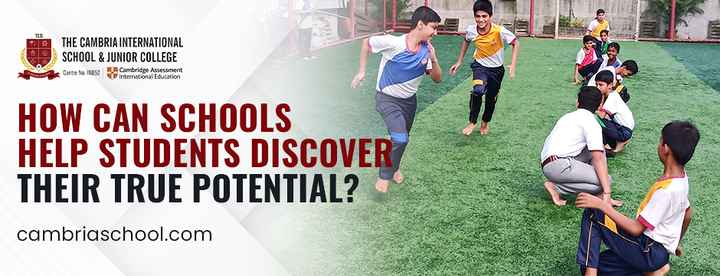
How Can Schools Help Students Discover Their True Potential?
Every child has unique abilities, interests, strengths, and ways of learning. While some students naturally excel in academics, others may shine through sports, music, art, technology, leadership, communication, or problem-solving. The CBSE schools in Kalyan West, therefore, should extend beyond completing the syllabus or preparing students for examinations.
It should create an environment where children can explore their interests, overcome challenges, build confidence, and understand what they are capable of achieving. When schools provide the right opportunities, guidance, encouragement, and support, students can gradually recognise their strengths and develop the confidence to turn their potential into meaningful accomplishments.
Create Opportunities Beyond Academics
Academic performance is important, but it represents only one aspect of a student’s abilities. Schools can help children discover their potential by exposing them to a broad range of activities.
These may include:
- Sports and physical activities
- Music, dance, and theatre
- Art, craft, and creative projects
- Debates and public speaking
- Science exhibitions and experiments
- Coding and technology activities
- Reading and writing programmes
- Leadership and community initiatives
When students experience different activities, they get opportunities to identify what genuinely excites them. A child who struggles to express themselves in a traditional classroom may discover remarkable confidence while performing on stage, participating in a sports team, or working on a creative project.
Encourage Curiosity and Questioning
Children discover their abilities when they are encouraged to ask questions rather than simply memorise answers. A classroom that welcomes curiosity can help students develop independent thinking and problem-solving skills.
Teachers can ask open-ended questions, encourage discussions, introduce real-world examples, and allow students to approach problems in different ways. This transforms learning from a routine academic exercise into an opportunity for exploration.
Instead of asking only, “What is the correct answer?”, educators can also ask:
- “Why do you think this happened?”
- “How could we solve this differently?”
- “What would happen if we changed one factor?”
- “Can you think of another approach?”
Such questions encourage students to think independently and become more comfortable with experimentation.
Provide Experiential Learning
Students often understand their abilities more clearly when they learn by doing. Practical activities, projects, experiments, field experiences, simulations, and collaborative assignments at the CBSE schools in Kalyan West can connect classroom concepts with everyday life. For example, a science project can reveal a student’s interest in research, while a group presentation can uncover communication or leadership abilities. Similarly, designing a model can encourage creativity and problem-solving.
Experiential learning also teaches children that making mistakes is part of learning. This can help them become more willing to try unfamiliar activities and take healthy risks.
Give Students Individual Attention
Every student develops at a different pace. Comparing children solely on marks can overlook important strengths that may not appear in examinations. Teachers can observe individual learning patterns and provide constructive feedback based on each child’s progress. Individual mentoring can help students understand where they are doing well and which areas they can improve.
Personalised guidance can also help identify students who need additional academic support or encouragement. When children feel that their teachers understand and value them as individuals, they are more likely to participate actively and express themselves.
Build a Safe and Supportive Environment
Students are unlikely to explore their potential if they are constantly afraid of failure or judgment. Schools should create an atmosphere where mistakes are treated as opportunities to learn.
A supportive environment encourages students to:
- Share their ideas without fear
- Ask for help when necessary
- Try new activities
- Learn from setbacks
- Accept constructive feedback
- Celebrate their own progress
Confidence does not develop overnight. It grows when students repeatedly experience encouragement, responsibility, effort, and small successes.
Help Students Develop Life Skills
Discovering potential is not only about identifying talents. Students also need skills that help them use those talents effectively.
Schools can intentionally develop:
- Communication skills
- Collaboration
- Leadership
- Time management
- Decision-making
- Emotional awareness
- Critical thinking
- Adaptability
- Responsibility
These skills prepare children to handle situations beyond examinations. A student may have excellent academic knowledge, but the ability to communicate, collaborate, and solve problems can make that knowledge more meaningful in real-world situations.
Encourage Leadership and Responsibility
Giving students age-appropriate responsibilities can reveal abilities that may otherwise remain unnoticed. Leadership opportunities can range from becoming a class representative to organising an event, leading a project, mentoring younger students, or participating in student councils.
A quiet student may demonstrate exceptional organisational ability, empathy, listening skills, or thoughtful decision-making. By allowing students to take responsibility, schools give them opportunities to understand their strengths while developing accountability and confidence.
Connect Learning With Real-World Experiences
Children often become more motivated when they understand why something matters. Schools can introduce students to real-world applications through projects, workshops, guest interactions, educational visits, career awareness programmes, and community activities.
For instance, mathematics can be connected with budgeting, science with environmental challenges, language with journalism or storytelling, and technology with practical problem-solving. These connections can help students discover possible interests and career directions without forcing them to make premature choices.
Celebrate Effort, Not Just Results
If schools celebrate only high marks and competition winners, students may begin to believe that achievement is the only measure of potential. Recognising effort, improvement, creativity, perseverance, teamwork, kindness, and responsible behaviour creates a broader definition of success.
A student who improves significantly from one term to another deserves recognition just as much as a student who consistently scores at the top. This approach teaches children that progress matters and encourages them to keep developing their abilities.
Partner With Parents
The best international schools and parents can work together to understand a child more completely. Teachers observe students in academic and social environments, while parents often understand their interests and behaviour outside school.
Regular communication can help both sides identify:
- Emerging interests
- Areas requiring additional support
- Changes in motivation
- Strengths that deserve further development
- Activities that may encourage confidence
This partnership creates consistency between school and home and helps children receive the encouragement they need.
Give Children Time to Explore
Discovering potential is a gradual process. Not every child immediately knows what they enjoy or what they are good at. Schools should therefore provide multiple opportunities for exploration instead of expecting students to identify their strengths instantly.
A child may try painting and lose interest, participate in athletics and discover a passion, join a robotics activity and develop curiosity about technology, or become interested in public speaking several years later. The objective is not to force every student into a particular path. It is to provide enough exposure for them to discover their own direction.
The Role of Schools in Shaping Confident Individuals
A school can become much more than a place where children attend classes. It can become an environment where they learn who they are, what they enjoy, what challenges them, and what they can contribute. When academics are combined with creativity, sports, practical learning, mentoring, leadership, collaboration, and values, students receive a more complete educational experience.
They learn not only to pursue achievement but also to understand themselves and develop the confidence to keep learning. Ultimately, discovering potential is not about finding one extraordinary talent in every child. It is about helping every student recognise their strengths, develop their abilities, overcome limitations, and believe that they can continue to grow.
Bottom Line
The CBSE schools in Kalyan West have a powerful role in helping students discover and develop their true potential. The right combination of academic learning, extracurricular opportunities, experiential education, personal mentoring, life skills, and emotional support can help children become confident and capable individuals.
For parents looking for a school that focuses on holistic development, The Cambria International School can be worth exploring. We emphasise a holistic, values-driven education, with opportunities spanning academics, sports, arts, leadership, and other areas of student development. We also cater to individual needs, offer a rigorous curriculum, and pay attention to students’ academic, social, and emotional growth.