
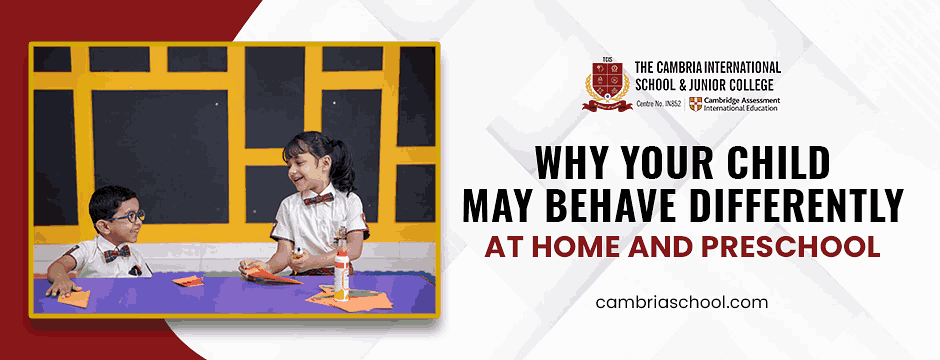
Why Does Your Child Behave Differently at Home and Preschool?
Have you ever heard your child’s preschool teacher describe a calm, cooperative child, only to see a completely different personality at home? Or perhaps your child behaves confidently at home but becomes quiet, hesitant, or emotional at preschool.
These differences can leave parents wondering whether something is wrong. In most cases, however, different behaviour in different settings is completely normal. Children respond to people, routines, expectations, and environments in different ways. Understanding these differences can help parents and teachers at the play schools in Kalyan support children without unnecessary worry or judgment.
Children Feel Different Emotions in Different Environments
A child does not experience home and preschool in the same way. Each environment has its own sounds, people, routines, expectations, and emotional atmosphere. At home, children usually feel deeply comfortable with their parents or caregivers. They know they can express frustration, excitement, tiredness, or disappointment without worrying about social expectations. This can sometimes lead to more emotional behaviour.
Preschool, on the other hand, has a structured environment. Children learn when to play, eat, clean up, listen, participate, and transition between activities. They gradually learn how to manage their behaviour within these expectations. This does not mean that a child is pretending at preschool. Instead, they are adapting to their surroundings.
Your Child May Save Big Emotions for Home
One common reason for different behaviour is emotional release.
A child may spend several hours at preschool following instructions, sharing toys, interacting with classmates, and managing emotions. This requires considerable effort, particularly for younger children.
Once they return home, they may finally feel safe enough to let those emotions out.
You might see:
- More tantrums
- Crying over small things
- Refusal to follow instructions
- Increased clinginess
- Irritability
- Sudden tiredness
- Strong reactions to ordinary requests
Parents may interpret this as bad behaviour. However, it can sometimes simply mean that the child is tired and needs emotional comfort.
A predictable after-school routine can help. Give your child some quiet time, offer a snack, and avoid immediately filling the afternoon with demands or activities.
Preschool Provides More Structure
The play schools in Kalyan can naturally influence children’s behaviour. At school, children generally know what is expected of them. Teachers may use visual schedules, repeated instructions, songs, classroom routines, and consistent boundaries to guide children through the day.
For example, a child may be allowed to choose when to play, which snack to eat, or which activity to do. When parents suddenly ask them to stop playing and get ready for dinner, resistance may follow. Neither environment is necessarily wrong. Children simply respond differently to different levels of structure. Parents can help by introducing a few predictable routines at home without trying to recreate the entire preschool experience.
Social Situations Can Change Behaviour
Children also behave differently depending on who is around them. At preschool, they may be surrounded by classmates. They learn to wait for their turn, share materials, listen to others, and negotiate during play. Some children become more outgoing in a group because they enjoy social interaction. Others may become quieter because they need more time to feel comfortable.
At home, siblings and parents create a completely different social dynamic. A child who happily shares at school may fight over toys with a sibling. Likewise, a child who rarely speaks in class may talk continuously at home. These differences can reflect the child’s comfort level, relationships, and social development rather than inconsistency.
Teachers and Parents Have Different Relationships With Children
Children understand that parents and teachers have different roles. A teacher may give a child an instruction using the same classroom routine they have followed many times. The child may respond immediately because they understand the expectation. At home, the same child might negotiate.
“Five more minutes.”
“I don’t want to.”
“Can I watch one more episode?”
This behaviour does not necessarily mean the child respects the teacher more than the parent. Children often test boundaries with the people they feel safest around. Parents can respond by setting clear, calm boundaries while still acknowledging the child’s feelings. For example, instead of repeatedly arguing about bedtime, a parent might say, “I know you want to keep playing. It is bedtime now.
This provides both empathy and a clear limit.
Some Children Need Time to Adjust
Preschool can also be a major developmental transition. A child who recently started preschool may behave differently because they are still learning how to navigate a new environment. They may initially be quiet, anxious, overly active, or unusually dependent on adults. These behaviours may change as familiarity develops.
Children also have different temperaments. Some immediately approach new people and activities. Others observe first and participate later. Giving children time to adjust can be more helpful than forcing them to behave like their more outgoing classmates.
Fatigue Can Affect Behaviour
Young children need substantial rest. Even when a child enjoys preschool, a full day of learning and social interaction can be tiring. Fatigue can affect patience, attention, emotional control, and cooperation. A child may appear focused and engaged at school but become extremely irritable after coming home. This can happen because they have reached the end of their emotional and physical energy for the day.
Consistent sleep routines, nutritious meals, hydration, and downtime can support better regulation. Parents should also consider whether too many after-school activities are leaving the child exhausted.
Children Learn Context-Specific Rules
Children are capable of understanding that different places have different expectations. At preschool, they may know that running indoors is not allowed. At home, they may have more freedom to move around. They may also understand that certain toys belong to the classroom, certain behaviours are expected during circle time, and certain activities happen only at particular times.
This ability to adjust behaviour based on context is actually an important social skill. The goal is not to make a child’s behaviour identical everywhere. Instead, parents and educators can work together to establish healthy, age-appropriate expectations.
Communication Between Parents and Teachers Matters
When behaviour appears very different between home and preschool, communication can provide useful context.
Instead of asking, “Why does my child behave perfectly at school but terribly at home?” parents can ask specific questions.
For example:
- When does my child seem most comfortable at preschool?
- How does my child respond to transitions?
- Does my child interact with other children?
- What happens before challenging behaviour occurs?
- What strategies help my child calm down?
- Are there particular activities my child enjoys?
Teachers at the best preschool in Kalyan East can also benefit from hearing about changes at home.
A child who slept poorly, experienced a major family change, or has been unusually emotional may behave differently at school. Sharing relevant information helps adults understand the child’s behaviour more accurately.
Avoid Comparing Your Child’s Two Personalities
It can be tempting to say, “Your teacher says you are so well behaved. Why can’t you behave like that at home?” However, comparisons can make children feel confused or ashamed. Instead, focus on the behaviour itself.
If your child struggles with transitions at home, help them practice transitions. If they become upset when asked to stop playing, provide warnings. If they struggle to express frustration, teach simple words for their feelings. The objective should be skill-building rather than forcing consistency.
When Should Parents Seek Additional Support?
Different behaviour across environments is usually not automatically concerning. However, parents may want to discuss persistent concerns with a paediatrician, child development professional, or preschool team when behaviour significantly interferes with learning, relationships, communication, safety, or everyday functioning.
Pay attention to patterns rather than one difficult afternoon. Consistent communication between caregivers can help identify whether a behaviour is part of normal development, a response to a particular situation, or something that deserves additional attention.
Final Thoughts
Children are constantly learning how to understand emotions, relationships, routines, and social expectations. Because home and the play schools in Kalyan offer different environments, it is natural for children to behave differently in each setting. Rather than viewing these differences as a problem, parents can use them as opportunities to understand their child’s needs and strengths.
A supportive preschool environment can play an important role in helping children develop confidence, independence, communication, and emotional skills. For families looking for a nurturing educational setting that supports children’s development, The Cambria International School can be explored as an option for early learning and preschool education.