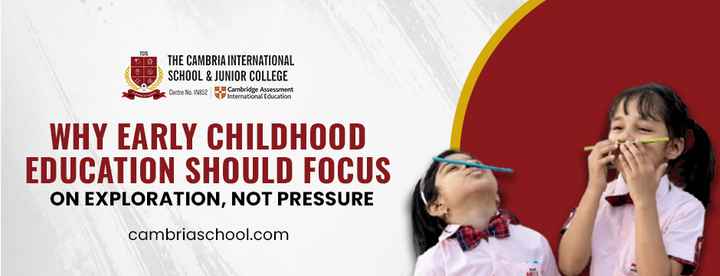
Why Early Childhood Education Should Focus on Exploration, Not Pressure
From asking endless questions to experimenting with everyday objects, children naturally learn by exploring the world around them. However, in today’s competitive environment, many young learners are introduced to academic pressure far earlier than necessary. While parents often have the best intentions, emphasising grades, structured lessons, and constant performance can unintentionally limit creativity and confidence.
Early childhood education should instead nurture curiosity, imagination, and joyful discovery. When children are encouraged to explore rather than pressured to perform, they develop a lifelong love for learning and stronger emotional, social, and cognitive skills. Educational research and the best international schools increasingly emphasise holistic, child-centred learning during these foundational years.
Understanding Early Childhood Education
Early childhood education refers to the learning experiences children receive during their formative years, generally from birth to around eight years of age. This stage is critical because the brain develops at an extraordinary pace, laying the foundation for future academic success, emotional intelligence, creativity, and problem-solving abilities.
Rather than focusing solely on reading, writing, or mathematics, quality early education aims to develop the whole child. It encourages children to build relationships, express themselves confidently, think independently, and develop essential life skills alongside academic readiness.
Children Learn Best Through Exploration
Children are naturally curious. Every new object, sound, texture, and experience becomes an opportunity to learn. Exploration allows children to understand their surroundings through direct interaction instead of memorisation.
Simple activities such as building with blocks, painting, gardening, storytelling, role-playing, or observing insects can teach valuable concepts related to science, mathematics, language, and creativity without making learning feel forced.
When children explore freely, they:
- Develop problem-solving skills
- Improve critical thinking
- Strengthen creativity
- Build confidence
- Learn through trial and error
- Become independent thinkers
Instead of fearing mistakes, they begin viewing challenges as opportunities to learn.
The Hidden Cost of Academic Pressure
Many parents believe introducing advanced academics at an early age gives children a competitive advantage. While structured learning certainly has its place, excessive pressure during the top preschools near me and primary years may produce unintended consequences.
Children experiencing constant performance expectations may:
- Lose interest in learning
- Develop anxiety around school
- Fear making mistakes
- Compare themselves with others
- Experience reduced creativity
- Become dependent on external validation
Young children are still developing emotionally. They need encouragement far more than constant evaluation.
Learning should inspire curiosity—not fear.
Play Is Serious Learning
To adults, play may appear simple entertainment. For children, it is one of the most effective learning tools available.
During play, children naturally practice communication, collaboration, reasoning, decision-making, and emotional regulation. For example:
Building Blocks
Children learn balance, shapes, counting, and spatial awareness while developing patience and perseverance.
Pretend Play
Role-playing as doctors, chefs, teachers, or astronauts encourages language development, empathy, imagination, and social interaction.
Outdoor Activities
Running, climbing, balancing, and exploring nature improve physical coordination while teaching observation and environmental awareness.
Art and Music
Drawing, painting, dancing, and singing strengthen creativity, fine motor skills, and emotional expression.
These experiences cannot be replaced by worksheets alone.
Curiosity Creates Lifelong Learners
Children who are encouraged to ask questions become active learners rather than passive recipients of information.
Instead of simply memorising answers, they begin asking:
- Why does it rain?
- How do birds fly?
- Why do plants grow?
- What happens if I mix these colours?
These questions stimulate deeper thinking and help children connect ideas naturally.
When curiosity is supported rather than discouraged, children remain motivated to learn throughout their lives.
Emotional Development Matters Just as Much
Academic knowledge is important, but emotional intelligence often determines how children navigate relationships, overcome challenges, and manage setbacks.
Exploration-based education creates opportunities for children to:
- Express emotions
- Practice empathy
- Build friendships
- Resolve conflicts
- Develop patience
- Learn resilience
For instance, sharing toys teaches cooperation, while completing a challenging puzzle develops persistence and confidence.
These experiences prepare children for both the best international schools and life.
Every Child Learns Differently
No two children develop at the same pace. Some children begin reading early, while others excel in music, art, communication, or logical thinking. Comparing children based solely on academic performance ignores their individual strengths.
Exploration-based learning respects these differences by allowing children to discover their unique interests and talents.
Instead of asking:
“Can every child learn the same way?”
Educators begin asking:
“How does each child learn best?”
This shift creates a more inclusive and supportive learning environment.
The Role of Teachers in Exploratory Learning
Teachers become facilitators rather than lecturers. Instead of providing every answer immediately, skilled educators guide children toward discovering solutions themselves. They encourage observation, discussion, experimentation, and reflection. For example, rather than explaining why objects float or sink, a teacher may ask children to predict outcomes before testing different objects in water.
This process builds reasoning skills while making learning memorable and enjoyable. Modern educational approaches increasingly emphasise experiential, hands-on learning that supports holistic development and intellectual curiosity.
Parents Are Partners in Exploration
Parents play a vital role by creating opportunities for exploration at home.
Simple activities include:
- Reading together daily
- Cooking simple recipes
- Gardening
- Visiting parks
- Exploring museums
- Solving puzzles
- Encouraging storytelling
- Asking open-ended questions
Instead of focusing only on grades, parents can celebrate curiosity, kindness, creativity, and effort.
Positive encouragement builds intrinsic motivation, helping children enjoy learning for its own sake.
Preparing Children for the Future
The future workplace will value much more than academic knowledge.
Employers increasingly seek individuals who can:
- Think critically
- Solve problems
- Adapt to change
- Collaborate effectively
- Communicate confidently
- Innovate creatively
These skills begin developing during early childhood—not through excessive testing, but through meaningful exploration and real-world experiences.
By allowing children to investigate, experiment, and imagine, educators prepare them not only for school but also for lifelong success.
Creating a Balanced Learning Environment
Exploration does not mean the absence of structure.
The most effective early childhood education balances guided instruction with opportunities for independent discovery.
A balanced classroom includes:
- Interactive learning activities
- Age-appropriate academics
- Creative arts
- Outdoor play
- Social interaction
- Hands-on experiments
- Storytelling
- Physical movement
This combination supports healthy development while maintaining children’s natural enthusiasm for learning.
Children remain engaged because learning feels meaningful rather than stressful.
Final Words
Early childhood education should be about nurturing curiosity rather than creating unnecessary pressure. When children are given the freedom to explore, ask questions, experiment, and learn through play, they build confidence, creativity, resilience, and a genuine love for learning that lasts a lifetime. Academic achievement is important, but it becomes far more meaningful when supported by strong emotional, social, and cognitive foundations.
The best international schools that embrace holistic, child-centred education help young learners grow into capable, independent, and compassionate individuals. The Cambria International School embodies this philosophy by fostering holistic development through experiential learning, modern academics, and a nurturing environment that encourages every child to discover their unique potential.