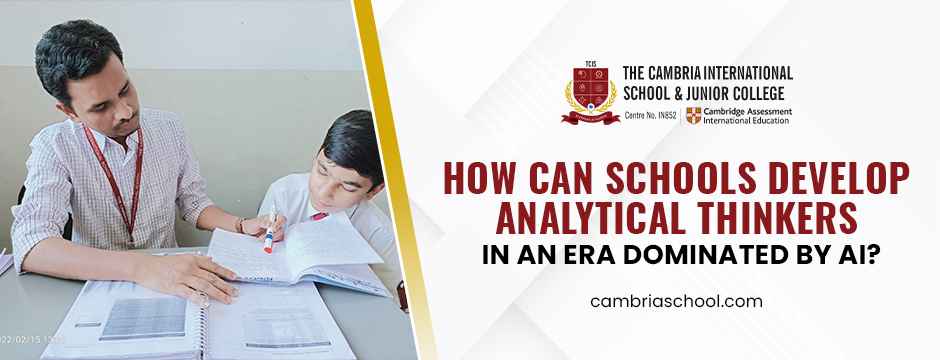
How Can Schools Develop Analytical Thinkers in an Era Dominated by AI?
Artificial Intelligence has changed the way students learn, research, write, and solve problems. With AI-powered tools capable of generating essays, solving mathematical equations, and answering complex questions within seconds, schools face a new challenge. The goal is no longer to help students memorise information but to teach them how to think critically, analyse evidence, and make informed decisions. Analytical thinking has become one of the most valuable life skills because AI can provide answers, but it cannot replace human judgment, curiosity, or ethical reasoning.
The international school in Kalyan that adapt their teaching methods to encourage questioning, reasoning, and creativity will prepare students to thrive in a future where humans and AI work together rather than compete. Research and education experts increasingly emphasise critical thinking, experiential learning, and AI literacy as essential skills for the next generation.
Why Analytical Thinking Matters More Than Ever?
Analytical thinking is the ability to examine information, identify patterns, evaluate evidence, and reach logical conclusions. It goes beyond memorising facts or repeating textbook definitions.
In the AI era, students can receive instant answers from chatbots and search engines. However, they still need to determine:
- Whether the information is accurate
- Whether multiple viewpoints exist
- How to apply the information to real-life situations
Students who simply accept AI-generated content without questioning it risk becoming passive learners. Schools must instead develop learners who ask “Why?” “How?” and “What if?” before accepting any answer. Experts describe analytical thinking as a core 21st-century competency that underpins problem-solving, creativity, and decision-making.
Shift from Memorisation to Understanding
Traditional education often rewarded students for remembering information. While foundational knowledge remains important, modern classrooms should prioritise understanding over memorisation.
Teachers at the international school in Kalyan can encourage this by:
- Asking open-ended questions
- Using real-life case studies
- Conducting classroom debates
- Encouraging multiple solutions to one problem
For example, instead of asking students to memorise historical dates, teachers can ask:
“How would history have changed if this event had never happened?”
Such discussions develop reasoning skills rather than memory alone.
Encourage Problem-Based Learning
Real-world problems rarely have one correct answer. Schools should introduce projects that require students to investigate, collaborate, and propose practical solutions.
Examples include:
- Designing eco-friendly school campuses
- Solving local community challenges
- Creating business ideas for social impact
- Developing scientific experiments
Problem-based learning encourages students to:
- Collect evidence
- Analyze data
- Test assumptions
- Improve solutions
These experiences mirror workplace challenges far better than standard examinations.
Teach Students to Question AI
AI should not be treated as an unquestionable authority.
Instead, schools should teach students how to evaluate AI-generated responses by asking:
- Is this information supported by reliable sources?
- Does another source agree?
- Are there missing viewpoints?
- Could the AI be incorrect?
Teachers can even ask students to intentionally identify errors in AI-generated answers.
This transforms AI from a shortcut into a learning partner rather than a replacement for thinking. Many educators now recommend integrating AI literacy with critical evaluation rather than banning AI outright.
Promote Inquiry-Based Classrooms
Curiosity is the foundation of analytical thinking.
Instead of providing immediate answers, teachers can encourage students to investigate independently.
Inquiry-based learning includes activities like:
- Research projects
- Classroom investigations
- Scientific observations
- Group discussions
- Student-led presentations
When students actively search for evidence instead of receiving ready-made information, they naturally develop stronger reasoning skills.
Use Collaborative Learning
Analytical thinking grows through discussion.
Working with classmates exposes students to different perspectives, allowing them to defend their opinions using logic and evidence.
Collaborative activities may include:
- Group research
- Team presentations
- Peer reviews
- Debate competitions
- Design thinking workshops
These experiences teach students that strong arguments require evidence rather than assumptions.
Make Reflection Part of Learning
Reflection is often overlooked in schools, yet it strengthens analytical thinking significantly.
After completing assignments, teachers can ask students:
- What worked well?
- What challenges did you face?
- Would you solve the problem differently next time?
- What evidence supports your conclusion?
Reflection encourages students to evaluate their own thought processes, making them more independent learners.
Integrate Cross-Disciplinary Learning
For instance, climate change combines:
- Science
- Geography
- Economics
- Politics
- Ethics
- Mathematics
Schools should design interdisciplinary projects where students connect concepts across subjects.
This broadens their perspective and improves systems thinking.
Redesign Assessments
If schools continue testing only memory, students will naturally rely on AI for answers.
Instead, assessments should measure:
- Logical reasoning
- Problem-solving
- Research ability
- Presentation skills
- Creativity
- Decision-making
Examples include:
- Case study analysis
- Open-book exams
- Research portfolios
- Oral presentations
- Real-world simulations
Performance-based assessments are increasingly recommended because they reveal how students think rather than what they remember.
Develop Digital and Information Literacy
Students today consume enormous amounts of information online.
The Top Schools in Kalyan West should teach them how to:
- Verify sources
- Detect misinformation
- Understand media bias
- Differentiate opinions from facts
- Evaluate online credibility
These skills become even more essential when AI-generated content can appear highly convincing.
Encourage Creativity Alongside Analysis
Analytical thinking and creativity complement each other.
Activities such as:
- Story writing
- Robotics
- Coding
- Music
- Art
- Entrepreneurship
Allow students to combine logic with imagination.
Creative challenges often require experimentation, adaptation, and continuous improvement—all essential analytical skills.
Create a Safe Environment for Questions
Many students hesitate to ask questions because they fear making mistakes.
Schools should normalise curiosity by celebrating thoughtful questions instead of only rewarding correct answers.
Teachers can regularly ask:
- “What assumptions are we making?”
- “Can someone challenge this idea?”
- “Is there another possible explanation?”
These discussions help students think independently.
Teachers Must Become Learning Coaches
The role of teachers is evolving.
Instead of being the sole providers of knowledge, teachers are becoming facilitators who guide students through complex thinking processes.
Modern educators should:
- Encourage discussion
- Challenge assumptions
- Provide constructive feedback
- Demonstrate critical evaluation
- Model ethical AI use
Technology can support teaching, but human mentorship remains irreplaceable.
Preparing Students for Future Careers
Future employers will increasingly value skills that AI cannot easily replace.
These include:
- Critical thinking
- Communication
- Leadership
- Ethical judgment
- Emotional intelligence
- Complex decision-making
Schools that nurture these abilities prepare students not only for careers but also for responsible citizenship. Education is no longer about competing with AI—it is about learning to work alongside it while preserving uniquely human strengths.
Conclusion
Artificial Intelligence is transforming education, but it should never replace human thinking. Instead, it presents an opportunity for schools to redefine learning by prioritising analytical thinking, curiosity, creativity, and ethical decision-making. Through inquiry-based learning, project-based education, collaborative discussions, thoughtful assessment methods, and responsible AI literacy, the international school in Kalyan can prepare students to become confident problem-solvers rather than passive consumers of information.
Institutions committed to nurturing future-ready learners play a vital role in this transformation. To explore an educational approach that focuses on holistic development, critical thinking, and academic excellence, visit The Cambria International School and discover how the right learning environment can help students thrive in an AI-driven world.